If you’ve ever experienced long term back pain there is a good chance your Doctor has referred you for imaging to help determine what may be causing your symptoms.
Once these scan results come back you can be confronted with lots of medical terms which can be overwhelming and sometimes scary. Some of the language used such as “degeneration” and disc bulges” can make us feel vulnerable and concerned. Many folk will turn to ‘Dr Google’ for answers, only to find conflicting information, worst-case scenario’s and surgery being a potential solution. With this fear comes heightened vigilance, increase in pain medication and avoidance of activity to avoid stirring up our ‘condition’. We can then become further de-conditioned, stiff and weak as well as reduce participation in the normal social and other activities we once enjoyed. MRI’s and other imaging tools can be very useful but we need to understand the results in the context of our circumstances.
The good news is that the medical terms used detailing your scan results can be very common and what is described within your results aren’t always symptomatic. The scan doesn’t always tell us where your pain is coming from!
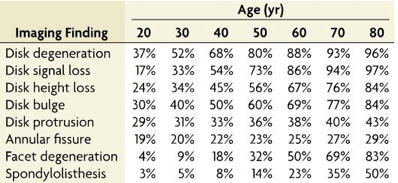
For example, the table above shows age specific prevalence of spinal degeneration (wear and tear) and other changes in asymptomatic (without pain) patients. [Brinjikji et al, 2015]
100% of these participants (all 3000 of them) had no back pain! This highlights that the results of your scan may not actually reveal the cause of the pain.
As demonstrated in the image above, age is a factor that can impact our scan results and as we age we have to expect general wear and tear on our body. Externally we can see grey hair and wrinkles, and our insides follow a similar ageing process but this doesn’t necessarily mean that pain and disability comes along as well. So, this means there may be other factors at play causing your back pain. These factors can include the way we move and load our bodies, posture, stress/mental health, fatigue levels, and many more.
As Exercise Physiologists and Physiotherapists, we aim to look at your pain condition with a holistic approach. We will certainly take your imaging results into account, but we need to understand the importance of treating the contributors and barriers to your pain, and not just the symptoms. We will look at how you move, your muscular strength, your physical demands for work/leisure, and even how your social/mental health may play a factor with your current pain levels and your goals.
There is a time and place where pain medications and surgical intervention may be necessary, and we don’t want to down play the importance of imaging which can play a vital role “ruling in” and “ruling out” certain pathologies. Fortunately, in the vast majority of cases imaging does not reveal serious pathology and with the right management plans people can achieve great results with a good quality of life beyond pain.
At the end of the day the spine is very strong and resilient, and you are not your imaging results!
Speak to your Doctor, Exercise Physiologist, or Physio about conservative therapy, do not panic, and start moving well.
An interesting Podcast with other great links regarding this topic:
Reference:
Brinjikji W, Luetmer PH, Comstock B, et al. Systematic literature review of imaging features of spinal degeneration in asymptomatic populations. AJNR Am J Neuroradiol. 2015;36(4):811-816. doi:10.3174/ajnr.A4173